The print method decides more about a mailer box’s cost and look than almost any other choice you make. The same dieline can arrive as a crisp full-color unboxing centerpiece or a clean two-color shipper depending on how the ink gets onto the board, and the right answer swings entirely on how many boxes you are ordering. Three processes cover the vast majority of custom mailers: digital, flexographic, and litho-laminated. This guide walks through what each does, where its economics make sense, and how to match the method to your order size instead of overpaying or underdelivering.
The three ways ink reaches corrugated
Digital printing sprays full-color CMYK straight onto the board with no plates. Because there is no tooling to make, it carries essentially zero setup cost and will run an order as small as a single box. It handles photographic images, gradients, and complex full-coverage artwork well, which makes it the natural fit for short runs, prototypes, seasonal variants, and any design that leans on rich imagery. The tradeoff is that its per-box price stays roughly flat as volume climbs; you never amortize a setup fee away, so at large quantities it stops being the cheapest route.
Flexographic printing uses raised rubber or polymer plates, one per color, to stamp ink onto the board. Those plates typically cost somewhere in the range of $200 to $800 or more each depending on size, and that cost is why flexo makes no sense for a handful of boxes. It shines with one to four spot colors and simple, bold graphics rather than fine gradients or photos. Once you spread the plate cost across a large run, though, the per-box price drops below what digital can offer, which is why flexo dominates high-volume shipping cartons.
Litho-lamination prints a sheet on an offset press, then laminates that printed sheet onto the corrugated board. It delivers the highest print fidelity of the three and supports premium finishes like foil, spot UV, and embossing, so it is the choice when a box is retail-facing and visual impact drives sales. The two-stage process adds plate costs, lamination, and longer lead times, which makes it the most expensive per unit until volumes get large enough to absorb that setup.
Where each method earns its keep
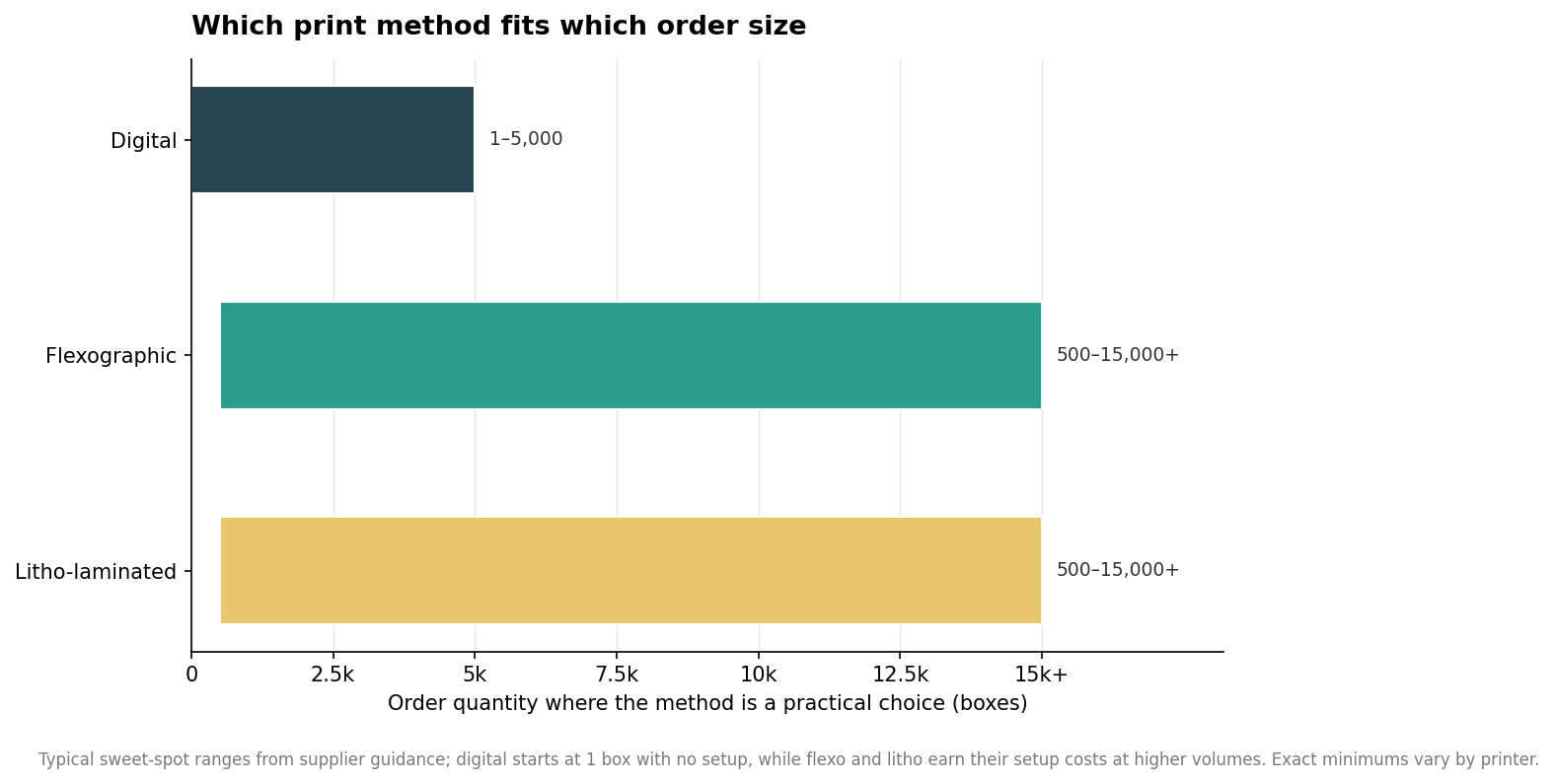
The decision is really a quantity decision. Digital owns the low and middle of the range, roughly from a single box up through a few thousand, because its zero-setup pricing beats any method carrying plate costs there. Flexo and litho typically start to make sense from around 500 units and up, but they only become the cheaper option once the run is large enough to dilute their setup. Industry guidance commonly points to litho-lamination’s per-unit cost dropping significantly past about 5,000 units.
A simple cost model shows why the crossover exists. If digital holds a flat price per box while flexo and litho spread a fixed setup across the run, the plated methods start expensive and fall as quantity rises, eventually crossing under the flat digital line. The exact crossover moves with color count, box size, and finish, but the shape is dependable: below it, digital wins on price and flexibility; above it, the plated methods win on unit cost.
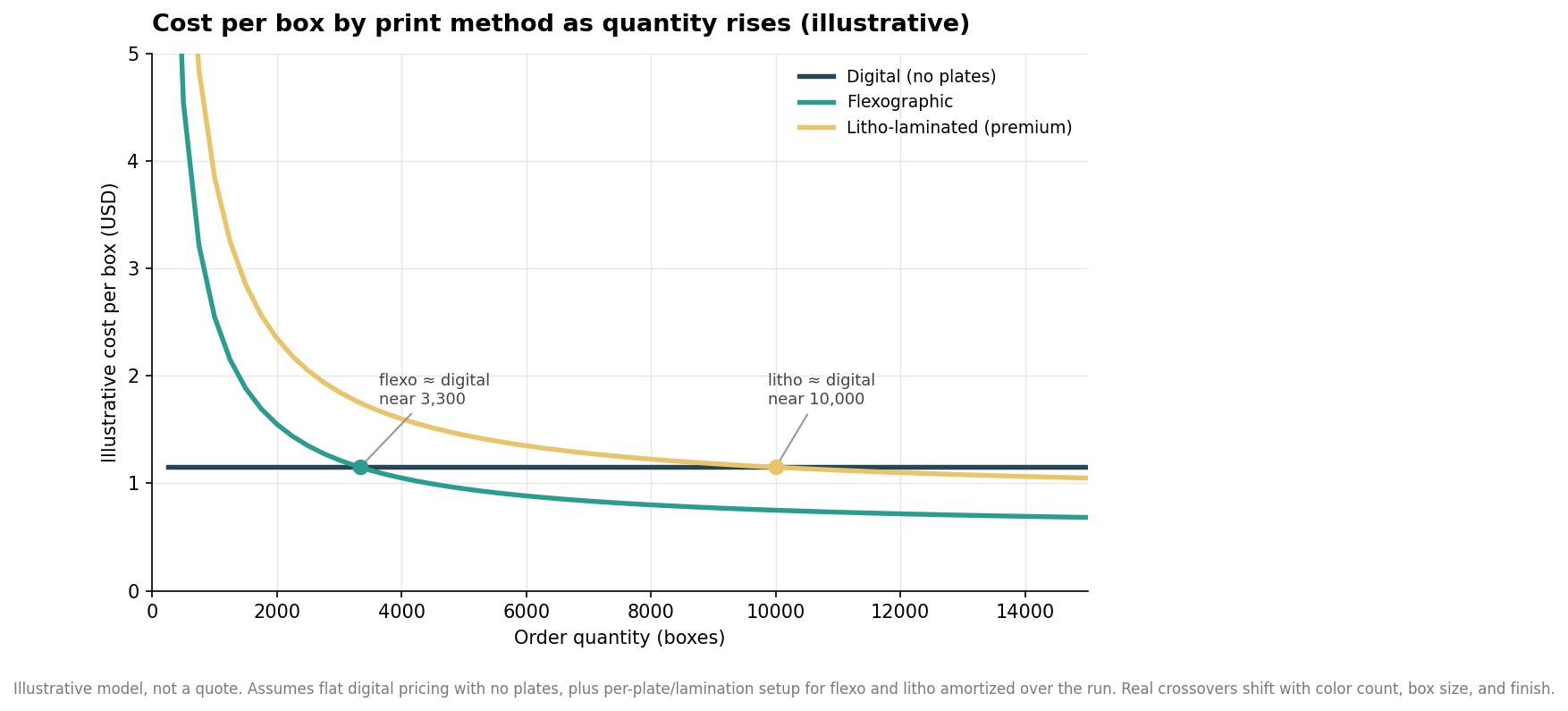
Two caveats keep this honest. The figures in the chart above are an illustrative model, not a quote; real pricing depends on your specific dimensions, board grade, number of colors, and any special finishes. And cost is not the only axis. A 2,000-box order of a photographic design may still be cheaper and better on digital even though flexo could technically run it, simply because matching that artwork in spot colors would be impractical.
Buying mistakes that quietly cost money
The most common error is ordering plates for a quantity that never needed them. A brand orders 750 boxes on flexo to feel established, pays several hundred dollars per plate, and ends up with a higher per-box cost than a plate-free digital run would have delivered at that volume. The mirror mistake is stretching digital into tens of thousands of identical boxes and paying its flat rate long after a plated method would have been cheaper. Both come from picking a process by reputation instead of by the math of the actual order.
Two smaller mistakes add up as well. Choosing litho for a design that has no photographic or premium-finish content pays for fidelity the artwork never uses, while trying to force a full-color photo onto a low-color flexo run produces muddy results that undercut the whole point of custom packaging. Match the process to what the design actually demands, not to a tier that sounds more premium.
Matching the method to your order
Work from your real numbers, in this order: quantity, then artwork, then finish. If you are ordering a few hundred to a few thousand boxes, or you need photographic imagery and full-bleed color, digital is almost always the right call and spares you any plate fees. If you are buying many thousands of a stable design with a handful of solid colors, flexo will usually deliver the lowest cost per box for a plain shipper. If the box is the first thing a customer sees and you want foil, spot UV, or a laminated sheen at scale, litho-lamination justifies its premium, provided your volume is high enough to absorb the setup.
One practical move saves the most money: lock the artwork before you commit to plates. Digital’s lack of tooling means a design change costs nothing but a new file, while a revision after flexo or litho plates are cut means paying for tooling twice. Prototype and approve on digital, then move the finalized design to a plated method once your volume clearly justifies it. Choose the process to fit the order rather than forcing the order to fit a process, and the box will look right and price right at the same time.