Ask three suppliers what a custom mailer box costs and you can easily get quotes that range from under a dollar to more than four dollars for what looks like the same box. That spread is not a mistake or a markup game. Mailer box pricing is built from a handful of levers, and once you understand which levers move the number the most, you can read a quote, compare vendors fairly, and specify a box that hits your budget without paying for things you do not need.
What a printed mailer box actually costs
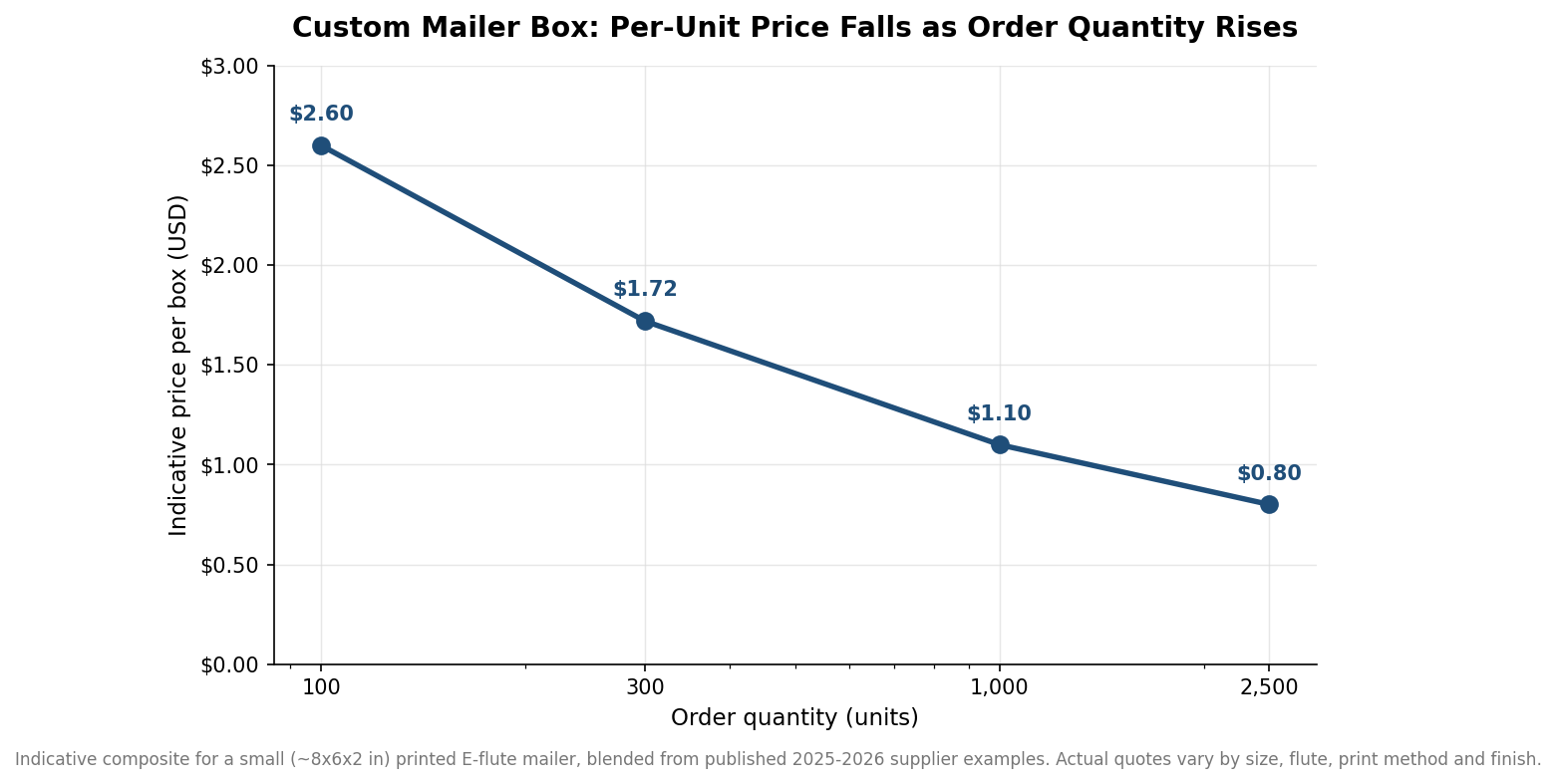
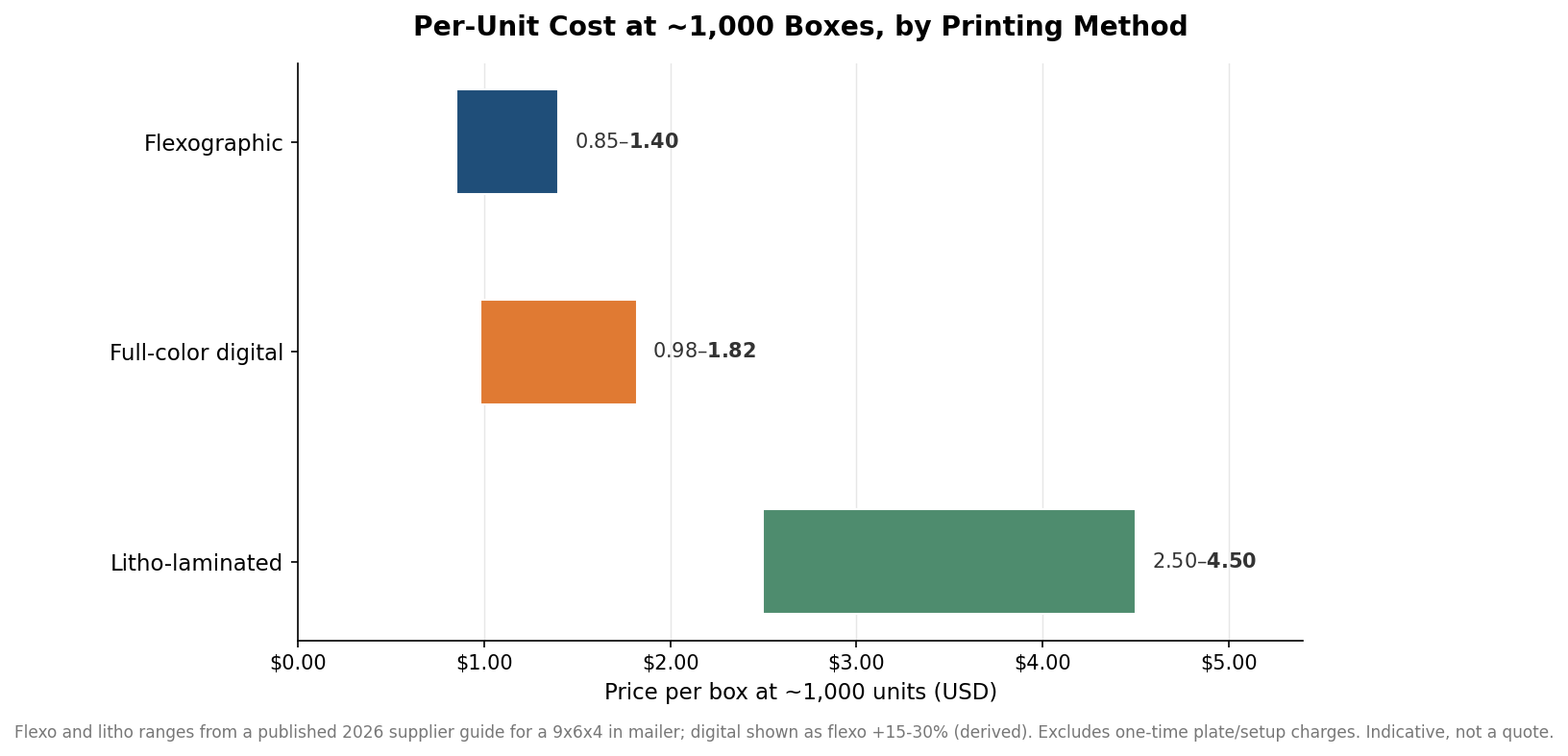
For a small, full-color E-flute mailer, published 2025-2026 supplier examples land roughly between $0.80 and $2.60 per box, with the low end reserved for larger runs and the high end for small test batches of a few hundred. A common reference point in the trade is a 9 by 6 by 4 inch flexo-printed mailer at 1,000 units, which several suppliers quote in the $0.85 to $1.40 range. Move to a retail-grade litho-laminated box at the same quantity and the same footprint can run $2.50 to $4.50. These are indicative figures rather than firm quotes, because the exact number depends on the levers described below, but they frame the territory you should expect to operate in.
Minimum order quantities usually start somewhere between 100 and 300 units for custom-printed corrugated, depending on the printer and the method. Below those thresholds the one-time setup costs simply have too few boxes to spread across, which is why a run of 50 fully printed boxes can cost more per unit than a run of 300.
Why quantity moves the price more than anything else
The single largest driver of per-unit cost is how many boxes you order, because most of what you pay up front is fixed regardless of run length. Tooling for the die, artwork setup, and print plates are charged once and then divided across every box in the run. Order 100 boxes and each one carries a large slice of that fixed cost. Order 2,500 of the same box and the slice per unit shrinks dramatically, which is why the curve above falls steeply between a few hundred and a couple of thousand units and then flattens.
Plate and setup charges are the reason. Flexographic printing typically carries plate charges of $200 to $1,500 per color per design, so a four-color flexo box can accumulate $1,200 to $3,000 in setup before a single box is produced. Spread that across 300 boxes and it dominates the price; spread it across 5,000 and it nearly disappears. This is also why buyers who expect to reorder often choose a slightly higher first run: the tooling is already paid for, and repeat orders skip most of the setup.
Printing method changes the whole equation
The print process you choose sets both your setup cost and your break-even quantity. Digital printing carries essentially no plate setup, which makes it the economical choice for shorter runs, generally from about 250 to 2,500 boxes. Because there is no per-color plate to pay for, digital is forgiving of complex, full-coverage artwork at low volume. Its downside is that the per-piece cost stops falling as fast at scale, so somewhere in the 2,000 to 3,000 range it typically becomes more expensive than flexo.
Flexographic printing flips that trade-off. You pay for plates up front, but the per-box cost at volume is low, which makes flexo the workhorse for runs of roughly 2,500 and up, especially for simple one-to-three-color designs. Litho-lamination sits at the premium end: a separately printed litho sheet is mounted to the corrugated board, giving photographic print quality suited to retail-ready packaging, and it generally makes sense at 1,000 units and above where the finish justifies the cost. Matching the method to your quantity and artwork is often worth more savings than shopping the same method across vendors.
Size, board grade, and finishes
After quantity and print method, the physical box is the next lever. Larger internal dimensions use more board, so cost scales with the surface area of the unfolded box rather than with volume in a neat way; a box that is only an inch larger in each direction can use noticeably more material. Board grade matters too. E-flute, the thin corrugated common to mailers, is the economical default and prints cleanly; heavier flutes or double-wall constructions add both protection and cost, and are usually reserved for heavier or more fragile contents.
Finishes are where budgets quietly inflate. A basic matte or gloss lamination is often included or inexpensive, but specialty touches add real money per unit: foil stamping and spot UV each require additional passes and, in the case of foil, additional tooling. Full-color printing on the inside of the box as well as the outside also raises the price, since it adds coverage and, in some constructions, another layer to the build. None of these are wrong to choose, but each should earn its place, because on a large run a small per-unit adder becomes a large line item.
Lead times and getting an accurate quote
Plan your calendar around the method. Standard custom corrugated production commonly runs 2 to 3 weeks from artwork approval, with a total corrugated turnaround often cited around 10 to 20 days once setup is included. Litho-laminated boxes take longer, frequently 4 to 6 weeks, because of the extra print-and-mount step. Rush production of 5 to 10 business days is usually available but tends to add a 15 to 30 percent premium, so building in lead time is one of the cheapest ways to control cost.
To get a quote you can actually compare, give every supplier the same brief: exact internal dimensions, the quantity or quantities you want priced, how many colors and whether you are printing inside and out, the board grade or flute if you know it, any finishes, and your shipping terms. Terms matter more than buyers expect, since duties-included pricing and duties-separate pricing can move the delivered number substantially. When you hold those variables constant, the quotes line up and the real differences between vendors become visible instead of hidden inside mismatched assumptions.