Two specifications decide whether a mailer box does its job, and neither is the print on the outside. One is the board itself, the corrugated structure that determines how much abuse the box absorbs. The other is its dimensions, which quietly set what the carrier charges you to ship it. Most buyers pick a size that looks right and a board the supplier defaults to, then wonder why boxes crush in transit or shipping invoices run high. Here is how to read both numbers.
Flute profiles: the wave inside the board
Corrugated board gets its strength from the fluted layer sandwiched between two liners, and flute size is graded by letter. The larger profiles are thick: A-flute runs about 4.0 to 4.8 millimeters and C-flute 3.2 to 4.0, with relatively few, tall flutes per foot that give cushioning and stacking strength for bigger shippers. B-flute sits around 2.5 millimeters. The smaller profiles are where mailer boxes live: E-flute is roughly 1.0 to 1.8 millimeters with 94 to 96 flutes per foot, and micro F-flute is thinner still at 0.8 to 1.0 millimeters.
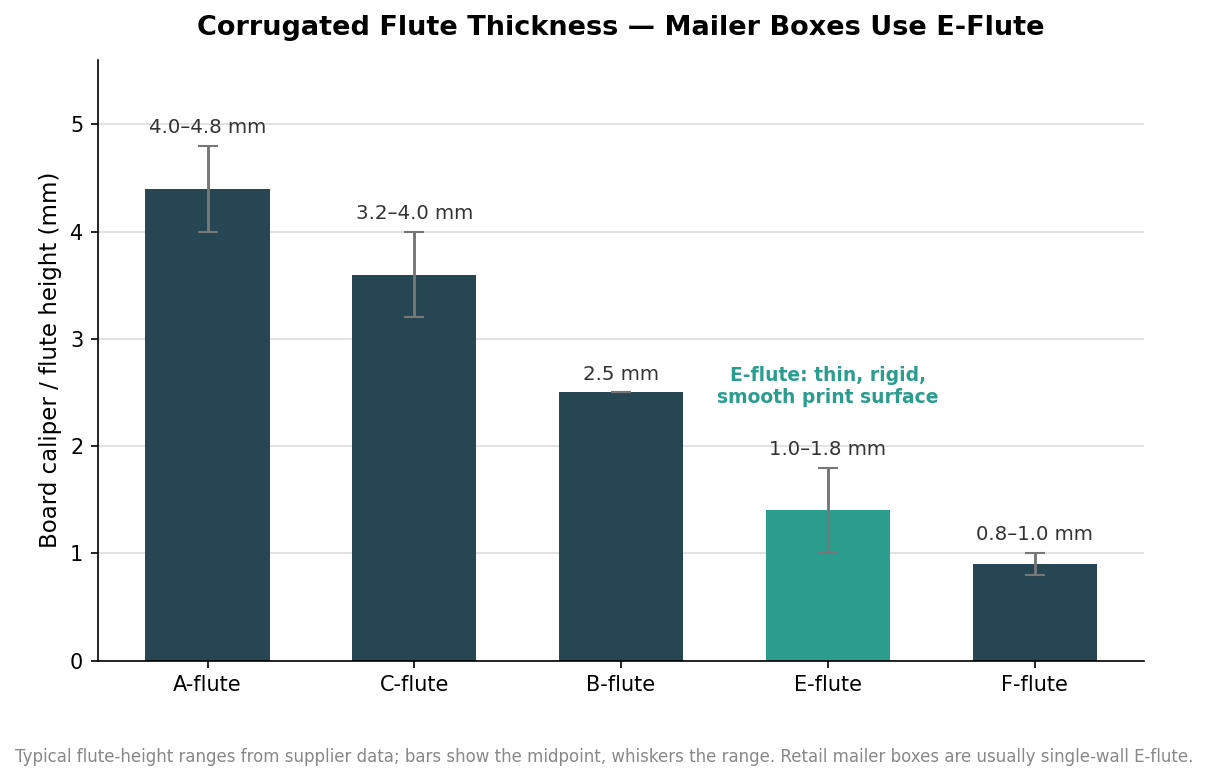
Retail mailer boxes are almost always single-wall E-flute, and for good reason. The tight, shallow flutes make a board that stays thin and rigid, folds crisply into the roll-end tuck shape a mailer uses, and presents a smooth, dense surface that prints cleanly, which matters when the box is a branding piece. Step up to B-flute when the contents are heavier or need more crush resistance and you can accept a slightly bulkier wall. Reserve the thick A and C flutes and double-wall constructions for larger shipping cartons, not unboxing-experience mailers.
Two ways to measure strength, and they are not the same
Board strength is certified two different ways, and confusing them leads to over- or under-buying. The Edge Crush Test (ECT) measures stacking strength, how much top-to-bottom load the board’s edges bear, reported as a number like 32 ECT. Roughly, 23 ECT supports around 20 pounds, 32 ECT around 65 pounds, and 44 ECT around 95 pounds of box contents in typical use. The Mullen or burst test measures something else entirely: puncture resistance, reported as a pound rating such as 200#, 275#, or 350#. A 200# burst board is the common standard-duty grade, with 275# for heavy-duty and 350# for industrial.
The key point is that ECT and burst are not interchangeable. A 32 ECT rating and a 200# burst rating are both “standard” single-wall grades and often quoted as rough equivalents, but one tells you about stacking on a pallet and the other about resisting a puncture. Wall construction sets the ceiling on both: single-wall board runs about 3 to 5 millimeters and handles roughly 20 to 120 pounds, double-wall runs 5 to 7 millimeters for 80 to 180 pounds, and triple-wall goes beyond that for freight. Ask your supplier which test their box maker’s certificate reports, and match it to how your boxes actually travel and store.
Reading the numbers for a mailer box specifically
For a direct-to-consumer mailer carrying a light product, most of this strength is headroom you may not need. A single-wall E-flute box in a standard grade already protects apparel, cosmetics, supplements, or small electronics through the parcel network, where boxes travel individually rather than stacked ten high on a pallet. Over-specifying to double-wall or a high ECT adds material cost and weight for protection a two-pound product will never call on. The smarter move for light goods is to hold a sensible standard board and put your attention on the dimension that actually drives cost.
Dimensional weight: why an empty inch costs money
Carriers stopped billing purely by scale weight years ago; now they bill by whichever is greater, actual weight or dimensional weight. Dimensional weight converts a box’s size into a billable weight using a divisor: length times width times height, in inches, divided by 139 for UPS and FedEx domestic shipments. USPS applies a divisor of 166 to Priority Mail packages over one cubic foot. Since a rule change that took effect in 2025, every fractional inch is rounded up to the next whole inch before the formula runs, so an 11.1 by 8.5 by 6.2 inch box is calculated as 12 by 9 by 7, inflating its dimensional weight by nearly 40 percent.
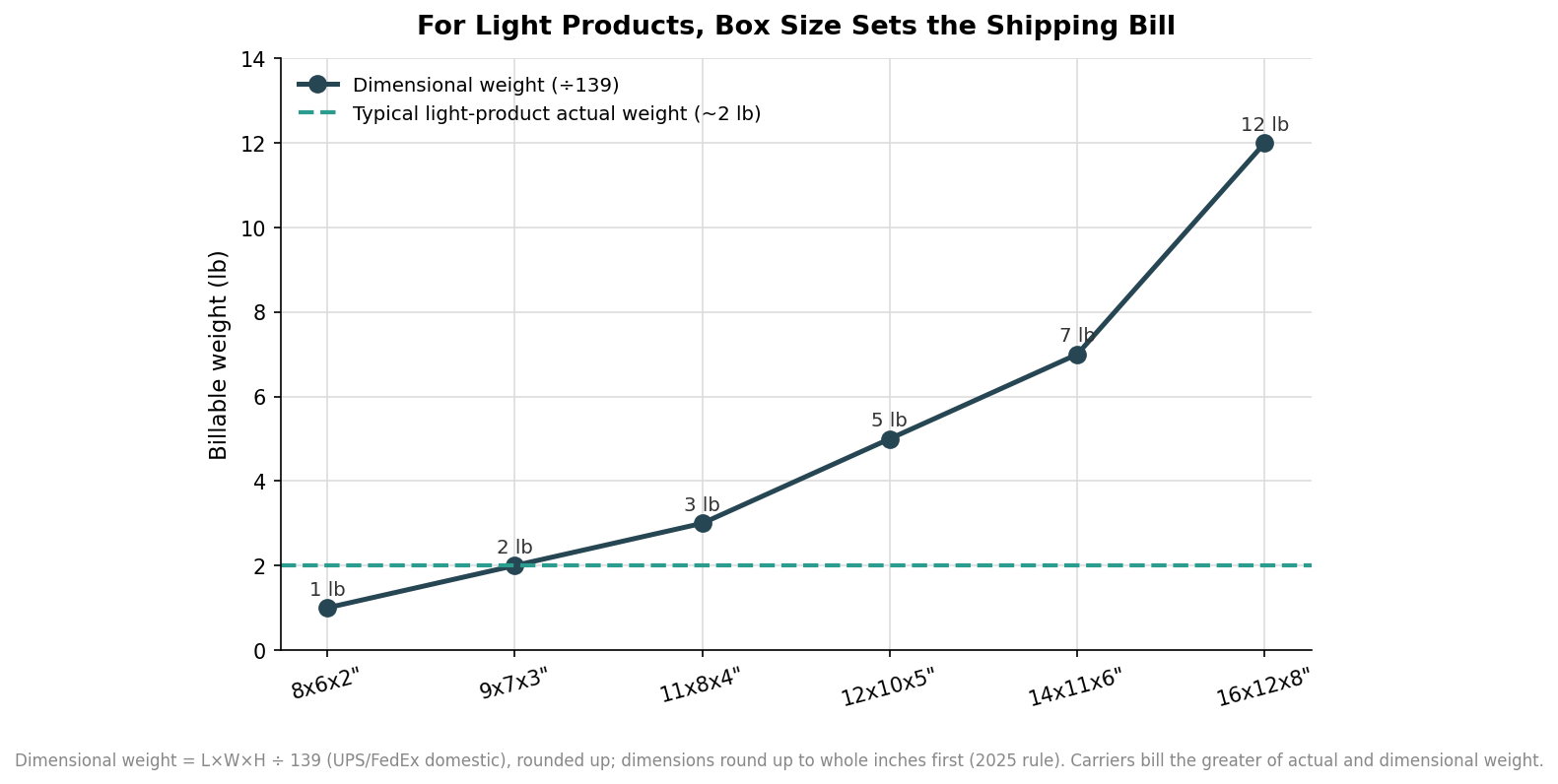
The consequence for a light product is stark. A roomy 16 by 12 by 8 inch box works out to 1,536 cubic inches, and 1,536 divided by 139 rounds up to a billable 12 pounds even if the actual contents weigh two. You pay to ship air. This is why the same product in a right-sized mailer can cost a third of what it costs in an oversized carton.
Specifying a mailer box to avoid the surcharge
Design the box to the product, then design the dimensions to the DIM rule. Measure the product with its protective void fill in place and choose internal dimensions with only the clearance you need, because every extra inch of height or width compounds in the volume calculation. Given the round-up rule, aim for whole-inch dimensions rather than landing at 6.2 inches and getting billed as 7. Where a product line spans a few sizes, a small ladder of right-sized mailers almost always beats one large box used for everything. Run your candidate dimensions through the divisor before you order, compare the result to the product’s actual weight, and you will know the real per-parcel cost before you commit to a die.
Get the board grade right so the box survives the trip, and get the dimensions right so you are not paying to ship empty space, and the specification is doing exactly what a good mailer box should: protecting the product without inflating the invoice.